
Adoption versus production
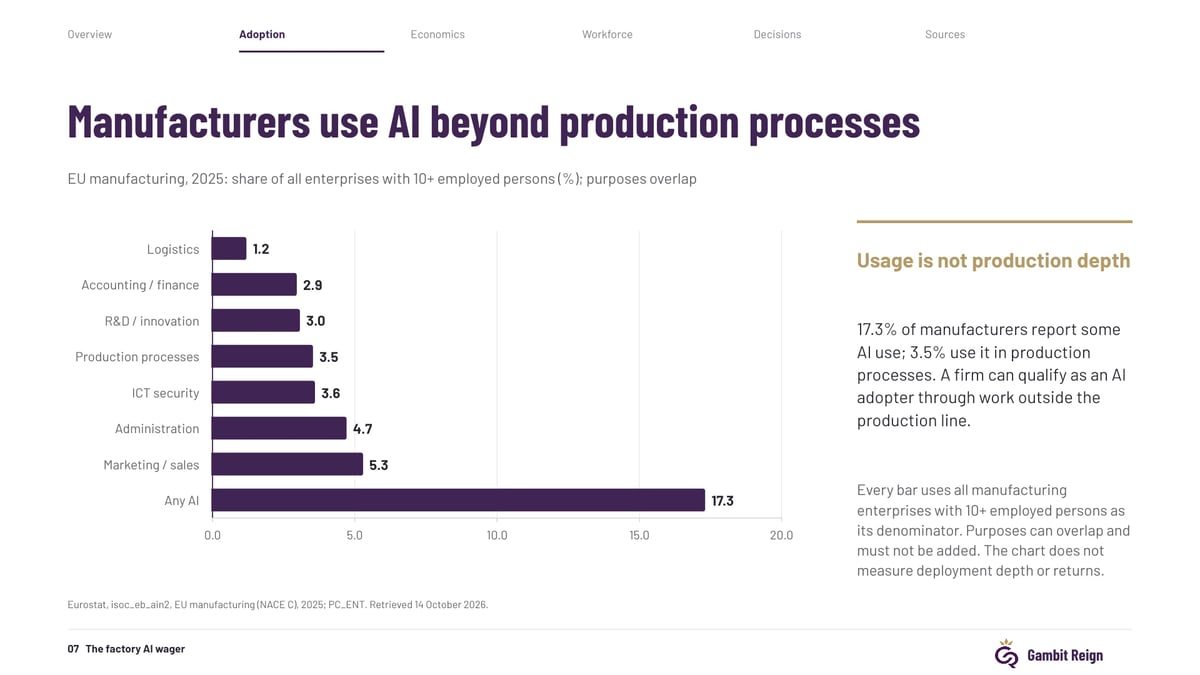
Eurostat reports 17.27% of EU manufacturing enterprises using any AI in 2025, versus 3.49% using it for production processes, among enterprises with 10 or more employed persons.
Intelligence Unit
Who captures the value when intelligence gets cheaper?
Drawing on 50 anonymised interviews across the GCC and Europe, alongside public statistics and research, GRIU examines what turns affordable AI into lasting factory value. The report explores integration, recurring support, contract economics, workforce judgment and control of deployment, with a practical framework for manufacturers and technology providers.
Access is not the outcome. The stronger wager is on a maintainable operating result, with evidence that survives changes of product, people and contract.
34-page PDF, free to download. We ask for your name and email so the Intelligence Unit knows who is reading.

Adoption is not the same as production depth, and a cheaper model does not settle who carries the cost or the responsibility.
Eurostat reports 17.27% of EU manufacturing enterprises using any AI in 2025, versus 3.49% using it for production processes, among enterprises with 10 or more employed persons.
Interview accounts distinguish easier configuration from physical integration and client validation. A simpler interface does not make the whole installation self-service.
Support obligations, volatile revenue and client-contract length can shape affordability beyond the model price.
Faster access to knowledge does not remove the need for practical competence, independent checks and clear authority over consequential actions.
Eurostat, EU manufacturing (NACE C) and covered market sectors, enterprises with 10 or more employed persons, 2025. Purposes overlap and must not be added.
Usage is not production depth. Every bar below uses all manufacturing enterprises with 10 or more employed persons as its denominator — a firm can qualify as an AI adopter through work outside the production line.
The report distinguishes qualitative interview themes, external statistics and GRIU interpretation. It does not claim representative interview prevalence, a country-by-country sample split or a universal project-cost ratio.
GRIU's deployment sequence. The report presents this as a decision aid, not engineering certification.
Do not widen authority when local evidence is incomplete. Revert or pause if quality, safety or recovery conditions fail acceptance.
34 pages on adoption, integration, contract economics and control of deployment — free to download.