
Cooling and water: one operating conversation for GCC hotels
Cooling towers consume water and reject heat; the water they consume is treated and paid for. Managing the two as separate conversations usually means neither is managed well.
- Byline
- Gambit Reign analysis
- Period covered
- 2023
- Reviewed
- 6 October 2026
- Topic
- Resource efficiency
- Reading time
- 6 min read
Key takeaways
- Cooling and water are physically coupled through the cooling plant, so a change to one affects the other. Managing them in separate departments means nobody sees the whole system.
- Effective management starts with a baseline that separates weather-driven, occupancy-driven and equipment-condition effects, because each points to a different action.
- Water treatment, hygiene and legionella control requirements are specialist and regulatory matters. Efficiency measures must be designed within those safeguards, never at their expense.
The conservation context
KAHRAMAA, Qatar's national water and electricity utility, publishes a sustainability report that includes Tarsheed, its national conservation programme. [F] The report documents the programme's activity and the national context of demand management for water and electricity. It is a national utility's account of its own conservation activity and is cited here as that: context for why demand management is a live subject in this market.
It is important to be precise about what such a document establishes. It describes programme activity and national direction. It does not establish the consumption, saving or performance of any individual property, and it should not be read as a benchmark for a hotel's cooling or water use. Reporting a national programme's figures as though they described a specific property would misrepresent both.
Equally, the tariffs applying to any particular property are a matter for that property's own contract with its utility. No tariff is asserted here, and none should be inferred from the national context or from the report.
Why the two conversations are really one
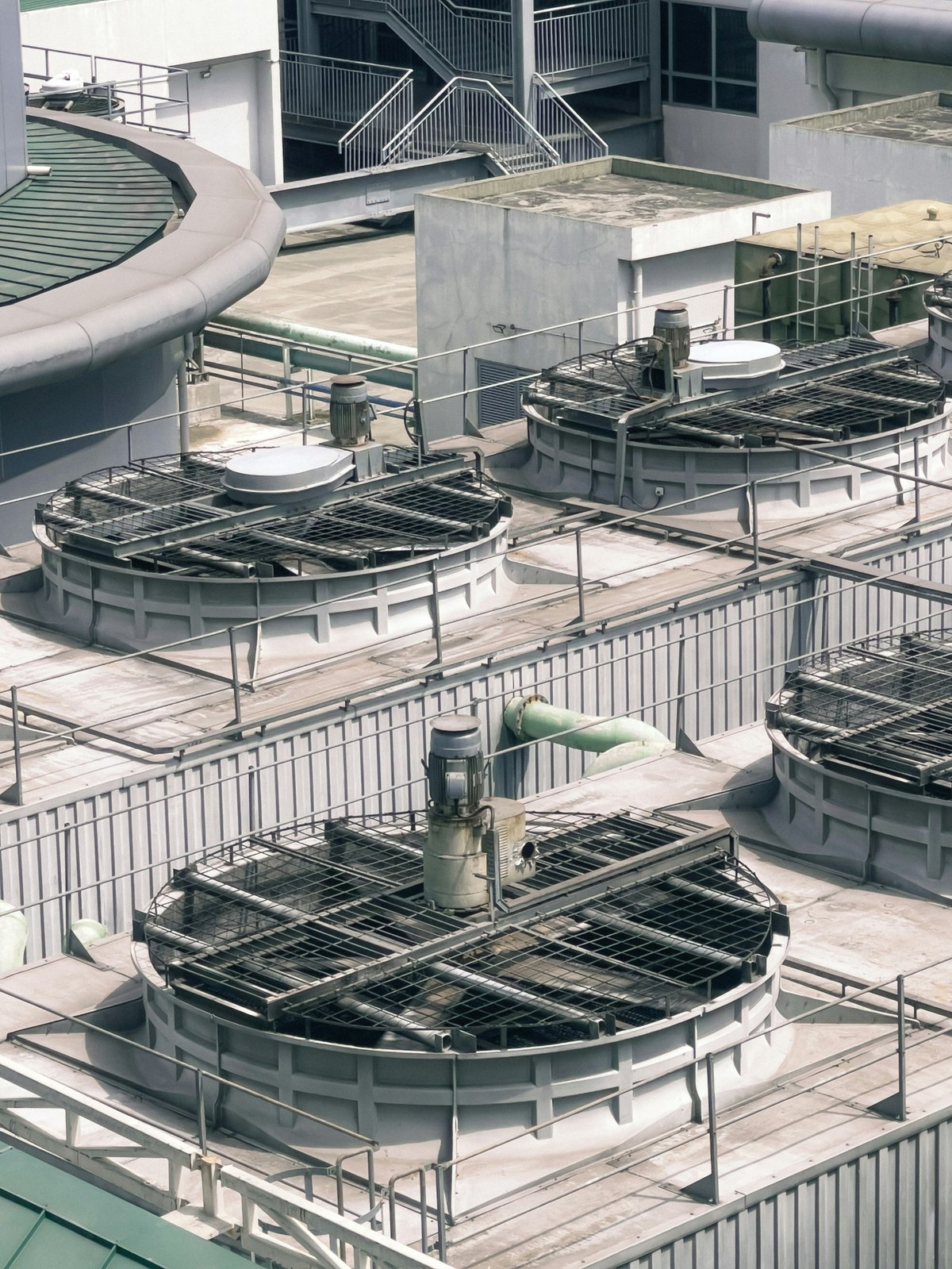
In a typical GCC hotel, chilled water for air conditioning is produced by chillers and the heat is rejected either to air-cooled condensers or to cooling towers. Where cooling towers are used, heat rejection happens by evaporating a portion of the circulating water, which means the cooling system consumes water continuously whenever it is running.
The water consumed is not raw. It is typically treated to protect the plant from scale, corrosion and biological growth, and the treatment itself carries cost — chemicals, monitoring, labour and the water that is deliberately bled off to control concentration. The relationship runs in both directions: a cooling system that is running inefficiently consumes more water, and a water system that is poorly treated degrades the heat transfer that the cooling system depends on.
This coupling is why separating the conversations is costly. If the engineering team manages plant condition and the sustainability or finance team manages water and energy accounts, an improvement identified on one side is often invisible to the other. The scale of water consumption in the cooling plant is frequently unknown to the people holding the water budget, because the boundary between 'cooling' and 'water' falls inside the same pipes.
The practical fix is organisational before it is technical: establish one operating conversation for cooling and water, with a shared view of the plant, its consumption and its condition.
Building a baseline that means something
Cooling consumption in a hotel moves with several independent variables, and a baseline that lumps them together cannot tell you what changed and why.
Weather is the largest driver in most GCC properties. Cooling degree days — a measure of how far and for how long outdoor temperature exceeds a reference — is the standard way to express this, and it allows consumption to be compared across periods of different weather. Without it, a cool month and a hot month look like a performance difference rather than a weather difference.
Occupancy is the second driver, though its effect is smaller than intuition suggests for cooling specifically, because common areas, corridors and back-of-house continue to be conditioned regardless. This is the same baseload effect that undermines per-occupied-room metrics, and it applies with particular force to cooling.
Equipment condition is the third, and it is the one that most often goes unmeasured. A fouled heat exchanger, a scaled condenser, a failing valve or an unbalanced system degrades performance gradually, and the degradation is attributed to weather or to plant age rather than to condition. Separating condition from weather and occupancy is what makes a maintenance intervention visible as a saving.
Sub-metering is what makes the separation possible: chilled water production separately from air handling, cooling tower make-up water separately from domestic water, and where feasible, major zones separately from the whole. The metering map is the foundation, and it is worth building before any intervention is specified. Where a property wants a published structure for what to measure and report, the criteria behind the EU Ecolabel for tourist accommodation [A] are a useful reference — though they are a labelling scheme's criteria, not a substitute for the property's own metering.
| Element | Who owns it | Data required | Review cadence |
|---|---|---|---|
| Chilled water production | Engineering / plant | Chiller energy, run hours, chilled water temperatures | Continuous metering, monthly review |
| Cooling tower make-up | Engineering / water treatment | Make-up volume, cycles of concentration, bleed volume | Continuous metering, review with treatment records |
| Water treatment and hygiene | Specialist contractor / compliance | Treatment records, monitoring results, inspection findings | Per the applicable regime and contract |
| Distribution losses | Engineering / maintenance | Consumption versus billed volume, night flow | Monthly review, investigate anomalies |
| Weather and occupancy drivers | Operations / sustainability | Cooling degree days, occupancy records | Monthly, aligned to the energy review |
This responsibility map is our own working structure. It records who holds which data and how often to review it; it makes no assumption about the treatment regime, water quality limits or tariff applicable to any property.
Leaks: the least glamorous and often the largest item
Before any efficiency measure is considered, it is worth establishing whether the property is losing water. Distribution losses on a large site — irrigation, pools, cooling towers, kitchens, laundry, guest bathrooms and long pipe runs — can be substantial and can persist undetected for long periods, particularly where a leak is below ground or in a rarely visited plant area.
Night flow analysis is the standard diagnostic. Consumption during the hours when the property is largely inactive is compared against the irreducible demand of that period, and a persistent excess indicates a loss. It requires interval metering at the relevant boundary and an understanding of which systems genuinely run overnight — the pools, for instance, and the cooling plant.
This matters for the cooling conversation because cooling tower systems are a common source: overflow from a poorly controlled sump, a stuck bleed valve, or drift from a fouled tower can waste water continuously. These are condition and control issues rather than design issues, and they are addressed by maintenance and monitoring rather than by capital expenditure.
The safeguards that constrain the options
Cooling water systems carry public-health and equipment-protection requirements that are not negotiable in the interests of efficiency, and this article deliberately does not go beyond stating that they exist and must be respected.
Water treatment regimes exist to control scale, corrosion and biological growth, and the last of these is a public-health matter subject to specific regulatory and specialist requirements in most jurisdictions, including requirements relating to the control of legionella and similar hazards. The specific limits, temperatures, concentrations and monitoring frequencies that apply to any system are matters of applicable regulation, industry guidance and specialist assessment — not matters on which this article can or should offer figures.
Two things follow. First, any measure that would alter treatment concentrations, water temperatures, circulation rates, blowdown practice or system operating patterns must be assessed and approved by the people responsible for water hygiene and compliance at the property before it is implemented; a reduction in water use that compromised the treatment regime would be a false economy with serious consequences. Second, efficiency measures in a cooling system should generally be sought in condition, control and maintenance — fouling, sequencing, setpoints within safe limits, and the elimination of simultaneous heating and cooling — rather than in any relaxation of treatment or hygiene practice.
Where a property has questions about its cooling water system, the appropriate route is its specialist water treatment contractor and the qualified engineers responsible for the plant, working within the applicable regulatory framework. Nothing in this article substitutes for that.
Limitations
- This article discusses how to organise the management of cooling and water in a hotel. It asserts no consumption, saving, tariff or performance figure for any property, and it does not state any water quality limit, treatment parameter or temperature.
- The cited utility report documents a national conservation programme. It does not establish the consumption or performance of any particular property, and no such inference should be drawn from it.
- Water treatment, cooling water hygiene, legionella control and the operation of cooling plant are specialist and regulated matters. All applicable requirements and any relevant industry guidance must be identified and followed, and specialist advice taken, before any change is made to a system.
- Tariffs, contract structures and metering arrangements are specific to each property and change over time. They should be verified directly with the relevant utility and from the property's own records.
The next decision
Find out how much water your cooling plant actually consumes — if nobody can answer that today, the metering comes before the measure.
Discuss your projectTaking this into your own project?
Our scoping guide and worksheet walk through the questions that make a brief usable — the decision, the evidence, the options including doing nothing, and what still has to be established. No email required.
Sources
External sources are referenced above by letter. Our own recommendations are identified as such in the text and are not attributed to these sources.
- [F]KAHRAMAA — 2023 Sustainability Report, including Tarsheed conservation activityhttps://www.km.qa/MediaCenter/Publications/20250217_KM%202023%20Sustainability%20Report%20%28Deliverable%205b%29.pdf
- [A]European Commission — EU Ecolabel: the official EU environmental labelling schemehttps://green-forum.ec.europa.eu/green-business/eu-ecolabel_en