
Sustainable hotel procurement: ask for evidence the purchase can use
Procurement decisions are where sustainability commitments either become operational or remain a statement. The test is whether the evidence supplied can support the buying decision.
- Byline
- Gambit Reign analysis
- Period covered
- 2025
- Reviewed
- 6 October 2026
- Topic
- Materials & packaging
- Reading time
- 5 min read
Key takeaways
- The EU Ecolabel is a voluntary official environmental labelling scheme. Its criteria are published, and a label on a specific product or service does not establish that a supplier's whole portfolio meets them.
- Procurement evidence should be assessed against four things: the scope of the label, the service performance the purchase requires, the total cost of ownership, and the validity of the evidence.
- Evidence expires, and suppliers change. A procurement system that records evidence with a validity date and a review trigger is more reliable than one that stores a certificate once.
What the EU Ecolabel is
The EU Ecolabel is a voluntary environmental labelling scheme operated at European level, established to identify products and services that meet published environmental criteria across their life cycle. [A] It is official: the criteria are developed and adopted through a defined process, they are published, and they are set out in decisions that can be read and checked.
For tourist accommodation specifically, there is a published set of criteria — Commission Decision (EU) 2017/175, as consolidated, which sets out the environmental criteria that accommodation services must meet to carry the label. [B] These criteria cover areas such as energy and water consumption, waste, use of renewable resources and communication.
Two points must be stated clearly, because they are commonly misread. First, the scheme is voluntary — a business chooses whether to seek the label, and in most markets a large share of accommodation does not carry it. Second, and more importantly for procurement: a label applies to a specific product or service that meets the criteria, and it does not extend to a supplier's entire portfolio. A supplier presenting a label should be asked which specific products hold it.
The criteria for any scheme also change over time, as they are reviewed and revised. The consolidated version cited is the historically current text at the time of preparation; where a specific compliance claim is to be made, the current criteria should be verified rather than assumed from a dated document.
A label is not a complete procurement argument
There is a tendency in sustainable procurement to treat a recognised label as the end of the assessment, on the reasoning that the criteria have already been checked by someone else. The reasoning is sound as far as it goes, and it does not go far enough.
A label answers a question about environmental criteria. It does not answer the questions a procurement decision actually turns on, several of which are equally important and none of which the label addresses.
Does the product perform the service required? A cleaning product that meets environmental criteria but does not clean to the required standard, or a linen that meets criteria but will not survive the property's laundry cycle, is not a sustainable purchase — it is a product that will be replaced sooner, generating more consumption, not less.
Does it work in this operation? A product designed for one context may not suit another. Water consumption of a laundry process, compatibility with existing equipment, staff training requirement and the effect on service times all matter and none is captured by an environmental label.
And what is the total cost? A product with a lower unit price but a shorter service life, higher failure rate, greater maintenance requirement or higher delivery cost is more expensive over its life. Total cost of ownership, not unit price, is the comparison that reflects what the business will actually spend.
Four tests for procurement evidence
The matrix below organises the assessment around four tests, applied to each significant category of purchase. It is a working structure rather than a scoring system, and it is deliberately designed to produce a documented answer for each line.
| Test | Question | Evidence to request | Failure mode |
|---|---|---|---|
| Scope | Which specific product or service does the claim cover? | The label or claim, with the product it applies to identified | A label applied to a portfolio it does not cover |
| Service performance | Does it perform to the required standard in this operation? | Trial data, technical specification, references | Criteria met, service requirement not |
| Total cost | What is the cost over the service life, not the unit price? | Whole-life cost including consumables, replacement and delivery | Lower unit price, higher life cost |
| Validity | Is the evidence current, and when does it expire? | Issue and expiry dates, version of criteria applied | Expired or superseded evidence carried forward |
| Supply continuity | What happens if the supplier or specification changes? | A qualified alternative, and notice of change | Category stranded when supplier withdraws |
This matrix is our own working framework. It asserts nothing about any specific product, supplier or label criteria, and it is not derived from or endorsed by the European Commission or any scheme owner.
Where this applies across a hotel's purchases
Three categories account for a large share of a hotel's non-food purchasing, and each has its own version of the four tests.
Linens and textiles are assessed on durability above all, because the environmental argument for a textile is realised over its service life. A product that meets criteria but wears faster than the incumbent may increase consumption rather than reduce it. The tests are therefore the laundry cycle the property actually runs, the expected number of cycles, and the supplier's evidence for it — followed by total cost across the life, not the cost per piece.
Cleaning products and services are assessed on performance first, because a cleaning product that does not clean to the required standard in the property's operations will be supplemented by another product, which defeats the purpose. The relevant checks are the dilution and dosing regime, compatibility with surfaces and equipment, the training the change requires, and the packaging format the property can actually handle.
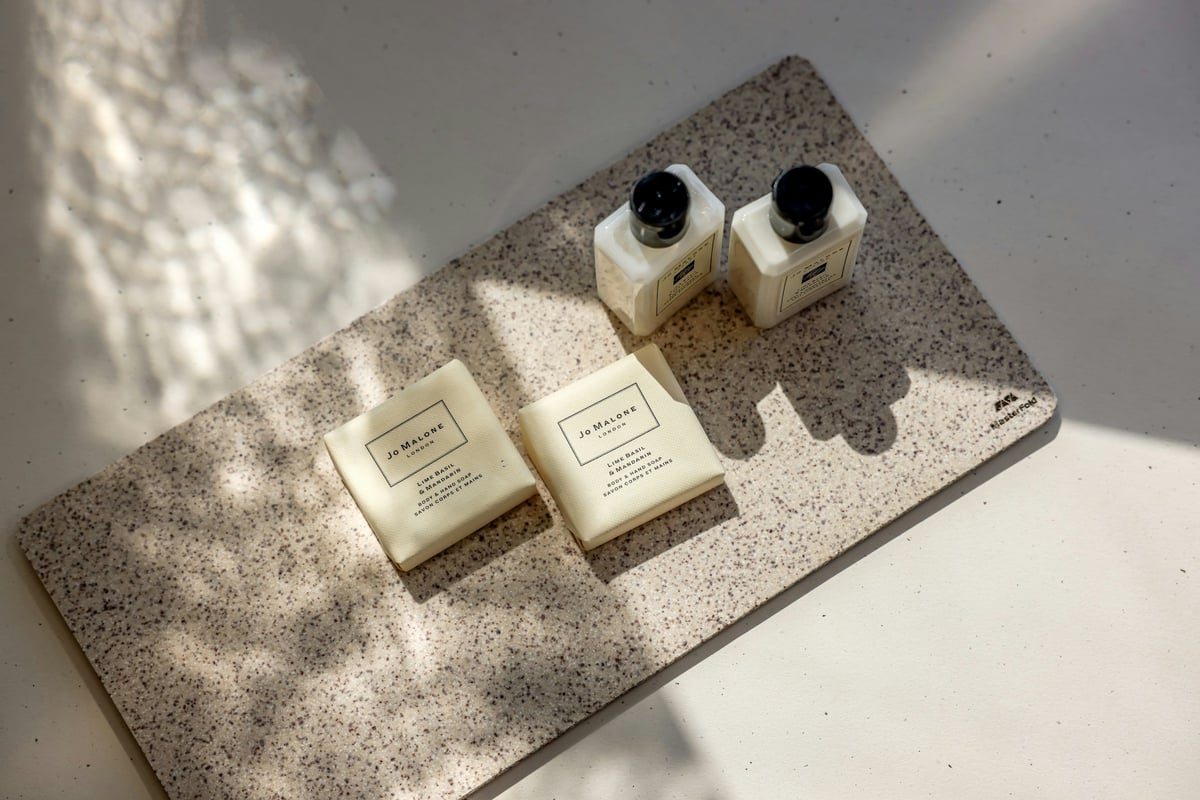
Amenities and equipment are assessed on the consumption they drive. A refillable amenity system changes the consumption profile substantially compared with single-use packaging and requires operational change to work. Equipment — refrigeration, laundry machinery, air handling — is assessed on the energy and water it consumes across its life and on its maintenance requirement, both of which usually outweigh the capital difference many times over.
Keeping the evidence alive
The most common failure in procurement evidence is not a poor initial assessment but the loss of currency afterward. Evidence collected at the point of purchase is filed, the contract runs, and the specification quietly changes — a supplier substitutes a material, reformulates a product, or relocates production, and the basis on which the purchase was justified no longer holds.
The remedy is administrative and simple to describe: record each piece of evidence with an expiry or review date, agree with the supplier that changes to specification, formulation or production location will be notified, and set a review trigger for the categories where the claim materially matters. Where the supplier cannot commit to notification, that itself is information about the durability of the evidence.
The scope discipline bears repeating here, because it is the most common error in the category. A label, a certificate or a claim on a brochure describes a specific product or service that has been assessed. It does not describe a supplier's entire range, and it does not describe a portfolio. Where a supplier presents a credential, the useful question is which products it applies to — and the useful answer is a list, not an assurance.
Limitations
- This article sets out a procurement assessment structure. It does not assess any product, supplier or label criteria, and it makes no claim that Gambit Reign or any hotel holds any certification, accreditation or label.
- The EU Ecolabel is a voluntary official scheme. A label applies to specific products or services that meet the published criteria; its presence on one product does not establish that a supplier's portfolio meets them. The criteria are reviewed periodically and the current text should be verified for any compliance purpose.
- The matrix presented is our own working framework. It is not derived from, endorsed by or affiliated with the European Commission or any scheme owner, and it does not reproduce the criteria themselves.
- Product performance, durability, supply arrangements and total cost are specific to the operation and change over time. Any procurement decision should be supported by the property's own trials and commercial assessment.
The next decision
Take one category you buy at scale and ask each supplier which specific products their credential covers — in writing.
Discuss your projectTaking this into your own project?
Our scoping guide and worksheet walk through the questions that make a brief usable — the decision, the evidence, the options including doing nothing, and what still has to be established. No email required.
Sources
External sources are referenced above by letter. Our own recommendations are identified as such in the text and are not attributed to these sources.
- [A]European Commission — EU Ecolabel: the official EU environmental labelling schemehttps://green-forum.ec.europa.eu/green-business/eu-ecolabel_en
- [B]EUR-Lex — Commission Decision (EU) 2017/175 on EU Ecolabel criteria for tourist accommodation (consolidated 20 December 2024)https://eur-lex.europa.eu/legal-content/en/TXT/?uri=CELEX%3A02017D0175-20241220