
The Factory AI Wager
Who captures the value when intelligence gets cheaper?
34 pages · Gambit Reign Intelligence Unit
Insights
Original analysis written by Gambit Reign on commercial strategy, project development and sustainable operations across our six industries. Each piece sets out what the available evidence supports, where the assumptions lie and what would change the conclusion — rather than presenting a single number without its basis. Coverage spans EU and GCC markets, including work that crosses the two.
Intelligence Unit
Who captures the value when intelligence gets cheaper?
34 pages · Gambit Reign Intelligence Unit
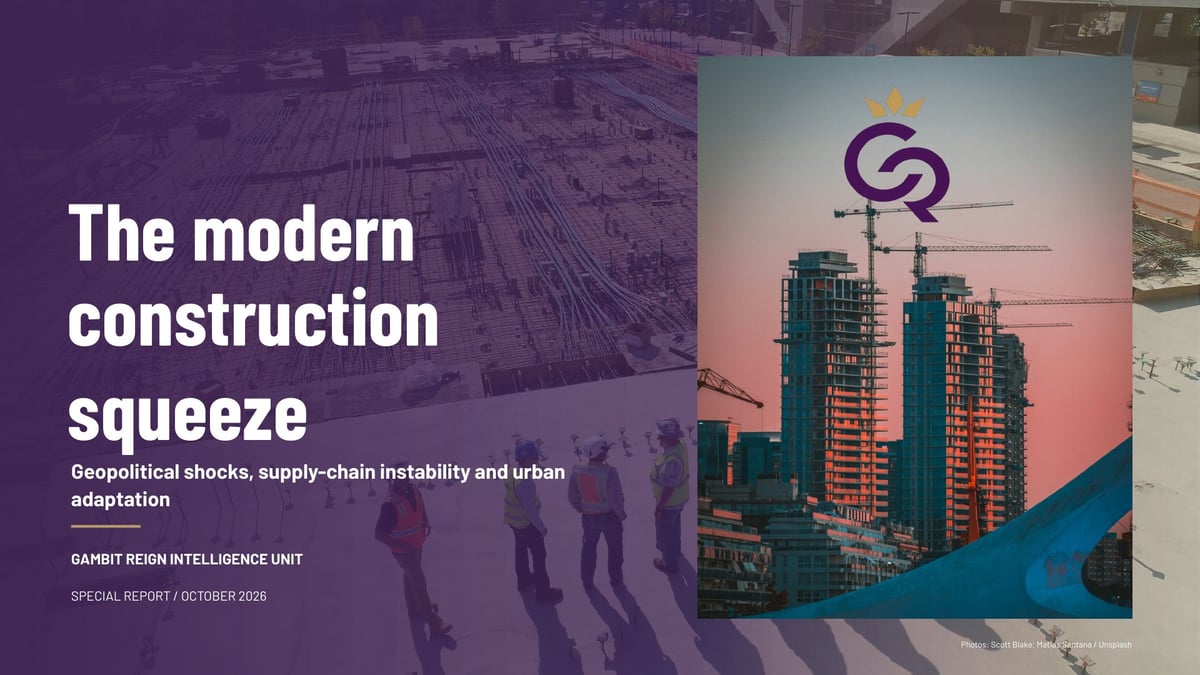
Geopolitical Shocks, Supply-Chain Instability and Urban Adaptation
36 pages · Gambit Reign Intelligence Unit

War, volatility and the resilient future of global aviation and tourism
28 pages · Gambit Reign Intelligence Unit
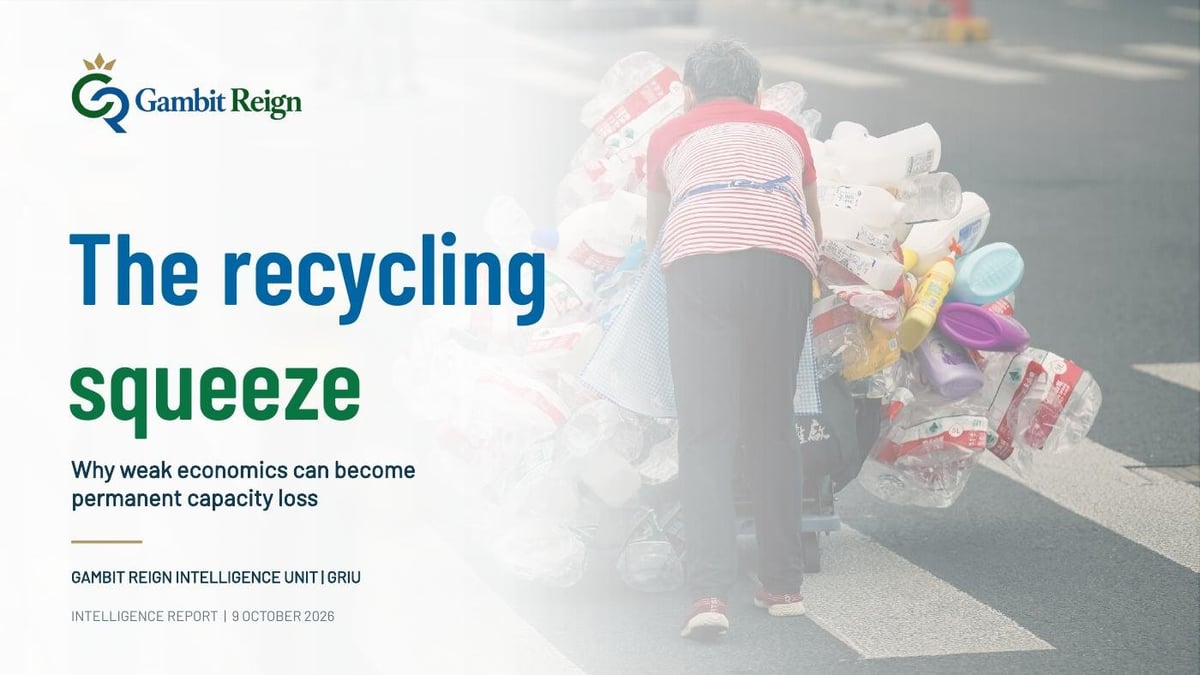
Why weak economics can become permanent capacity loss
28 pages · Gambit Reign Intelligence Unit
EU and GCC each include cross-region analysis; EU–GCC comparisons shows cross-region pieces only.
A period covering several years matches each year within it — a 2022–2024 piece appears under 2022, 2023 and 2024.
60 articles in the library
Recycling & Resource Recovery
A recycling project's route is a design decision, not a logistics detail. Where the material goes determines what can be done with it and when.
Plastics & Packaging
A phased measure on defined products is best answered with a solution that delivers the same outcome, not always with a substitute that happens to be permitted.
Manufacturing
The same production data can serve several reporting demands — provided you separate what is genuinely portable from what is jurisdiction-specific.
Construction & Built Environment
A large quantity of material in the built environment is not the same as a large quantity of material available to use. The distance between them is the whole question.
Recycling & Resource Recovery
Whether material is waste or a product changes which framework applies to it. That question comes before any question about quality or documentation.
Recycling & Resource Recovery
A feasibility study built on an estimated national tonnage is built on someone else's number for someone else's question. A defensible baseline is your own.
Our insights combine commercial and operational expertise with original analysis of EU and GCC markets. We draw on relevant regulation, industry evidence and cited sources to test our reasoning and explain what the findings mean for business decisions.
Each piece connects that expertise and analysis to a practical question: what a business needs to understand, decide or do next.
Examples are explicit about their assumptions. Where we work through a scenario, we state what we have assumed so that readers can substitute their own figures and test whether the conclusion still holds.
Where a question turns on local licensing, site conditions or legal interpretation, we say so. The evidence and approach page sets out how we weigh sources and includes worked examples.